Campus events
Sustainability
Corporate 19 October 2020
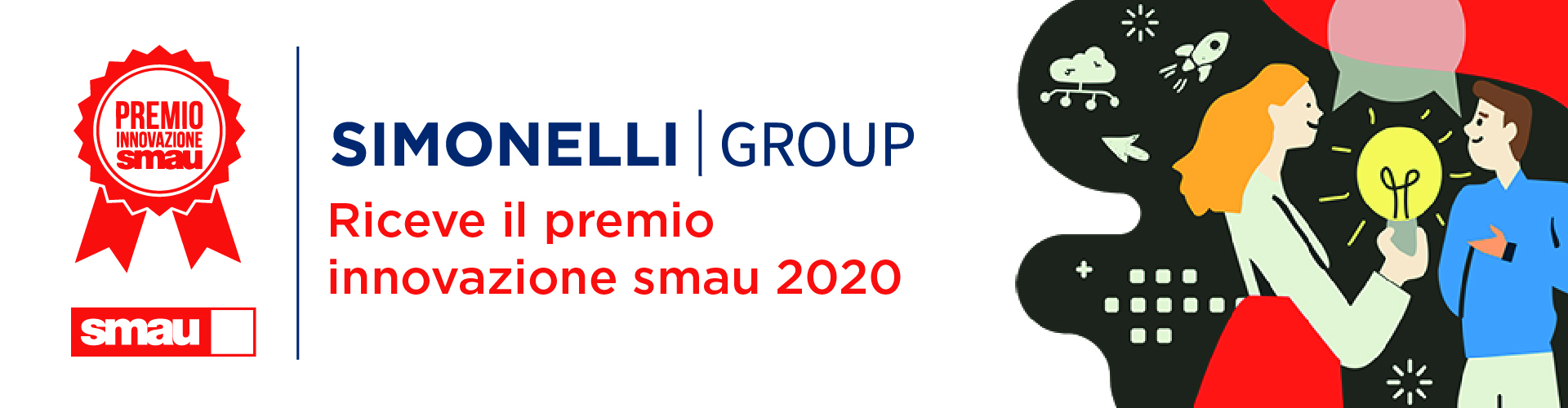
On October 20, Simonelli Group receives the SMAU Innovation Award at Mico in FieraMilanoCity, Milan, the recognition to companies, administrations and entities that have taken the path of Open Innovation by collaborating with companies or startups to innovate. The awards ceremony takes place during the two-day SMAU, which confirms itself as the benchmark event for the national and international innovation ecosystem and the leading business matching platform in Italy.
Simonelli Group, in addition to receiving the SMAU Innovation Award, will present its case study as part of the Smau Live Show scheduled for Tuesday, Oct. 20, from 1:30 to 2:20 p.m. at TV Studio 1 at MiCoLab in Fieramilanocity. “In an industry where there is no single energy certification, we have given ourselves a very clear goal: every new professional coffee machine must consume less energy, limit emissions and reduce environmental impact by respecting the philosophy of less is more“-recalls Mauro Parrini, chief operating officer of Simonelli Group. Parrini, who will be present at the SMAU Live Show, stresses that sustainability is “one of the most important objectives of the research activity carried out by the company.” The Simonelli group approach, in fact, is part of the broader commitment of the entire coffee production chain and translates into a series of concrete actions aimed at ensuring sustainability in all its forms: environmental, economic and social. In this direction, a first initiative concerns the Belforte del Chienti plant, which since 2005 has been equipped with a photovoltaic system and the entire building has been designed to make the most of sunlight throughout the day.
“Despite the fact that there is no unified certification system for the professional coffee machine,” Parrini continues, “at Simonelli we have developed a special focus on assessing the environmental impact throughout the life cycle of the professional coffee machine in order to define the critical phases of the life cycle and possible improvement interventions (eco-design, ed.).” Thanks to the coffee machine life cycle study (the standardized Life Cycle Assessment methodology), for example, it was found that 95-98% of the CO2 produced relates to the energy used in coffee shops, to make coffee and cappuccinos. “Machines must therefore be designed to be increasingly efficient in terms of energy savings, life cycle and emissions. In particular, with the use of materials that reduce heat loss and with technologies such as T.E.R.S. (Thermal Energy Recovery System), which can recover the heat still present in the coffee brewing water in excess to preheat the water entering the system, we are able to decrease consumption-about 8 percent with T.E.R.S. alone-while increasing machine performance.”
This type of production approach at Simonelli has made it possible-and even more so in the future-to reduce costs and waste, with significant benefits for the environment and for customers’ budgets.
Stories
Campus events
Sustainability
Campus events
Corporate
Training
Campus events
Training
Corporate

Campus events
Corporate
Corporate
Corporate

Campus events
Corporate