The circular economy and the coffee machine
The circular economy research project to obtain salvaged and innovative components for a Victoria Arduino coffee machine.
Reducing theenvironmental impact of products and reducing energy consumption are issues that Simonelli Group has been addressing for quite some time, so much so that they are part of the company’s research and development drivers.
One of the latest research projects contributing to Simonelli Group’s transition to a circular economy aims to recover composite materials that can be reused again for the design and manufacture of new composite materials, which today have wide use and application due to their strength and durability characteristics, but at the same time are very difficult to dispose of.
The “De-Manufacturing” research project, developed by Delta srl and Simonelli Group, falls within the Marche Region ‘s MARLIC (Marche Applied Research Laboratory for Innovative Composites) platform under “Sustainable Manufacturing: eco-sustainability of products and processes for new materials and de-manufacturing.” Indeed, the challenge of reusing composite materials meets a strong need, as it will correspond not only to the improvement of environmental sustainability, but will also register important technological, economic and social spin-offs. In fact, it will be possible not only to reduce their flows, but also to identify those technologies capable of making composite materials, a material that can be used again for products or uses in different supply chains, also responding to the need, never as current as in this particular historical moment, for energy savings and new resources.

Victoria Arduino’s Eagle One Coffee Machine
“In collaboration with Delta srl (a Plados-Telma Group company, one of the world’s leading manufacturers of composite kitchen sinks, ed.), University of Camerino, Università Politecnica delle Marche, CNR and ENEA,” said Mauro Parrini, COO Simonelli Group SpA, “we have formulated green recipes (different ways and processes for reusing composite material, ed.) using recovered raw materials as a partial replacement for virgin raw materials. We carried out innovative molding tests of the side panels of the coffee machine Eagle One by Victoria Arduino using composite materials recovered from Delta products, resulting in a truly sustainable fairing with very interesting features: it is antibacterial, has a very high surface hardness and thus long life, and the color remains unchanged and stable over time. In addition, during the research stages we transformed into new resource and thus obtained new raw material the composite material of a colander top from which we produced the coffee bell lid of the Mythos grinder. These are two examples,” Parrini continues, “of the possibilities that arise from what to all intents and purposes can be defined as ‘industrial symbiosis,’ where material, the result of one company’s production, does not close its life cycle by becoming waste, but rather re-enters the production cycle, becoming a resource, a raw material for another company’s production.

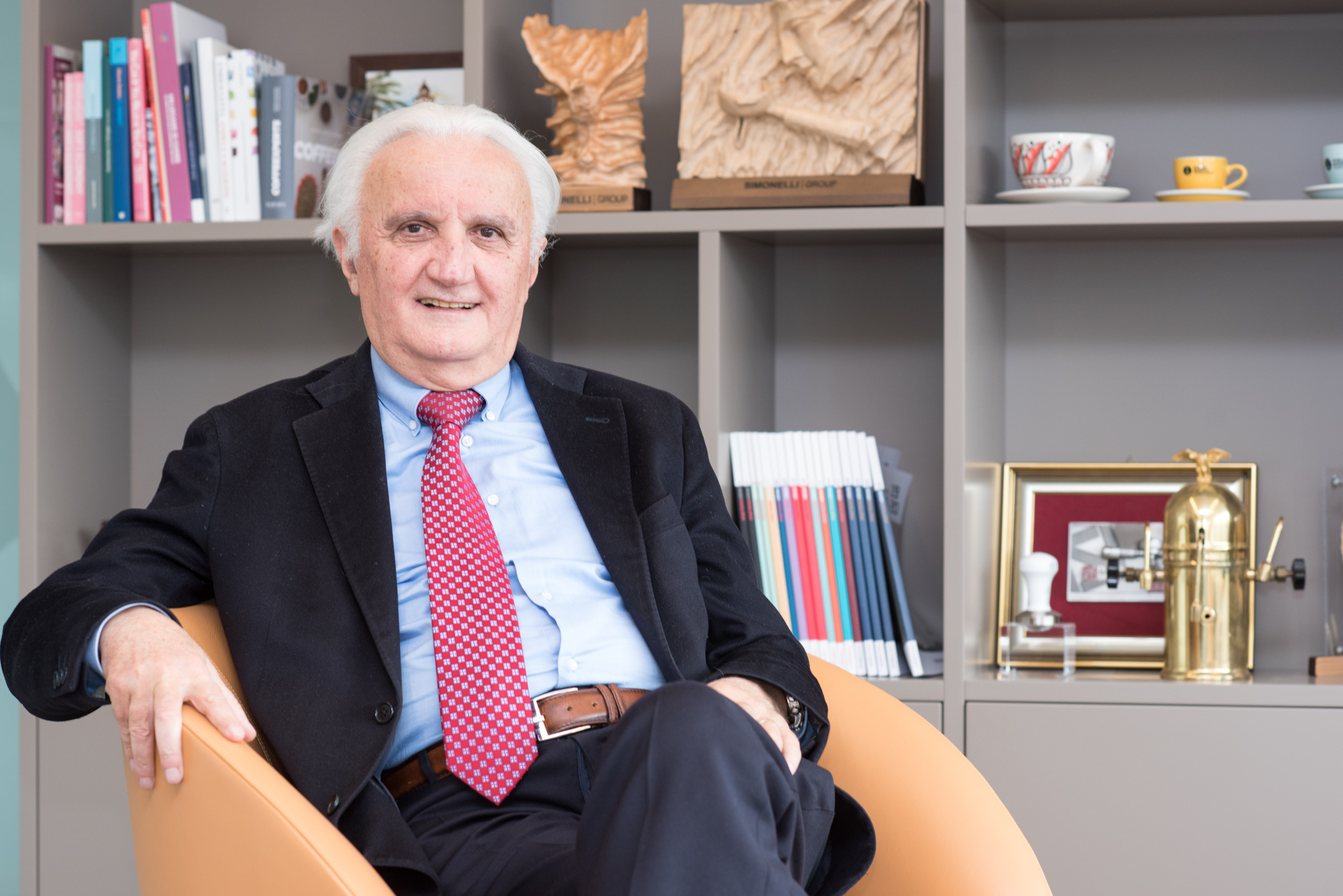
Mauro Parrini, COO Simonelli Group SpA
Delta and Simonelli Group’s De-Manufacturing projectand resulted in a synergistic operation that sought to concretize the philosophy of the 4Rs, pillars of the circular economy: Resource Reduction, Reuse, Recycling and Recovery.
“We are really happy to actively participate in these virtuous synergies, which are also promoted and developed within the MARLIC Platform as advocates of a twofold goal: to make a strong contribution to the transition to a circular economy and to grow and develop the local industrial system,” said Fabio Ceccarani, CEO Simonelli Group. “The De-Manufacturing project is in addition to a series of research and projects over the years that have enabled us to improve the extraction performance of machines through the extensive use of emerging technologies and to cut down on energy consumption, which accounts for more than 90 percent of the environmental impact of all coffee machines.”
ABOUT MARLIC: Marche Applied Research Laboratory for Innovative Composites (acronym: MARLIC) is the platform of the Marche Region within the framework of “Sustainable Manufacturing: eco-sustainability of products and processes for new materials and de-manufacturing.”
The Project, funded by the Marche Region under ROP Marche FESR 2014-2020 , involves a working group of 27 individuals led by the lead company HP Composites. Also joining HP are 20 companies including Simonelli Group, the Marche Cluster Foundation, and five research centers including the University of Camerino, the Polytechnic University of Marche, the University of Urbino, ENEA, and CNR.